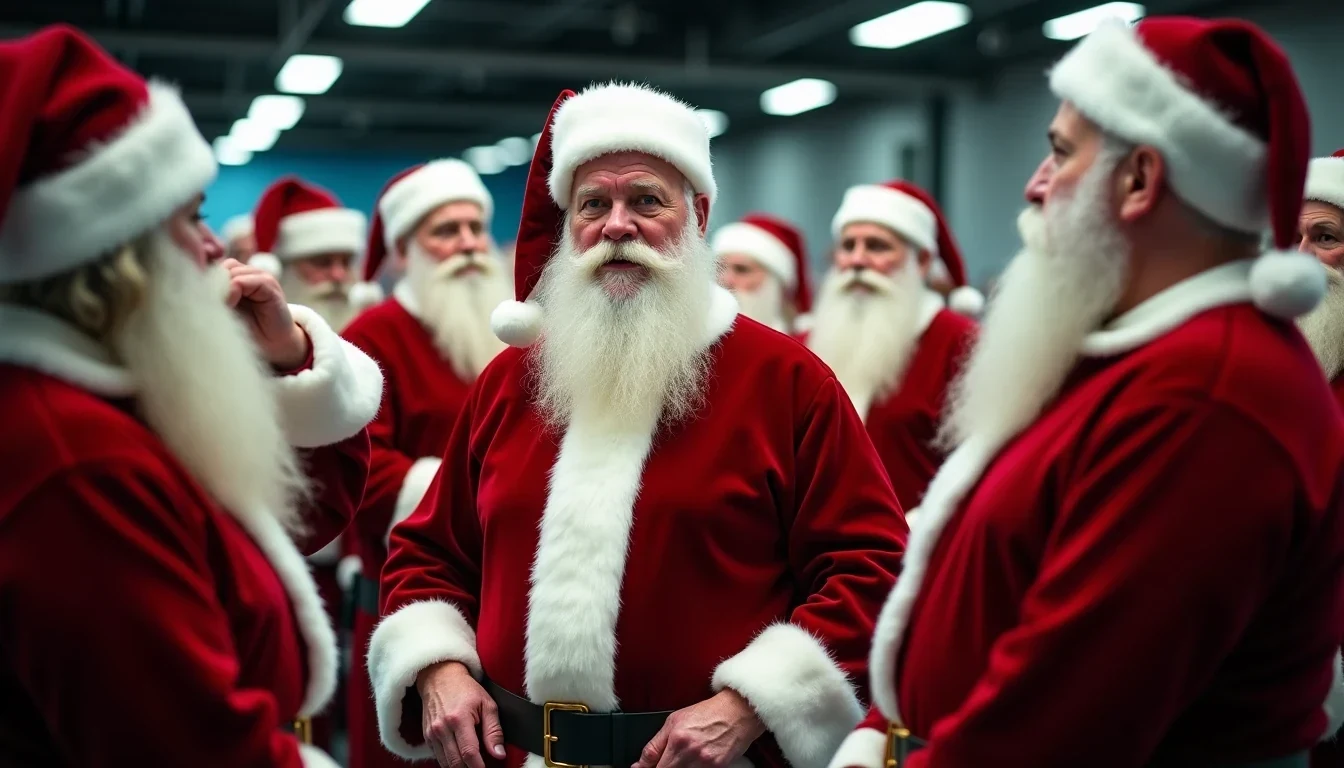
There is no sleigh. There is no reindeer parking. There is a convention centre in Aalborg, Denmark, and 150 grown men in full velvet suffering through 32-degree July heat while arguing about whether their boots should be black or dark brown. The World Santa Claus Congress happens in mid-summer because December is when every single person in this room is actually working. You cannot network when you are booked solid in four shopping malls and a private grotto in Qatar.
What Actually Happened
The congress runs for three days and the schedule reads like any other trade show. Morning sessions on costume fabric durability. Afternoon workshops on handling children who ask why Santa’s beard is synthetic. Evening parades through Aalborg where locals watch bemused as Santas from seventeen countries wave from floats, already sweating through their long johns. The Danes invented this event in 1957 and have hosted it every year since, which makes it older than most professional bodies that actual lawyers belong to.
Delegates arrive with business cards and grievances. A Finnish Santa wants recognition that Joulupukki lives in Korvatunturi, not the North Pole. A Dutch delegate needs advice on whether Zwarte Piet still works as a companion figure. An American mall Santa has developed a cooling vest prototype and wants manufacturing partners. Everyone has a position on the red question. Coca-Cola red is too commercial. Crimson reads purple under fluorescent lights. The true shade should match the 1931 Haddon Sundblom illustrations, or maybe it should not, because that was an advertising campaign and we are meant to represent folklore. This argument has lasted decades.
The heat management discussions are practical and desperate. Full suits run four to six kilograms. Synthetic beards trap moisture against the neck. One veteran from Queensland, Australia, recommends merino wool underlayers because they wick sweat without smelling after twelve-hour shifts. Another swears by gel packs sewn into the suit lining, replaced every ninety minutes. Nobody suggests performing in short sleeves. The suit is the job. The suffering is the job.
The Aftermath
Children’s questions get their own training module because the wrong answer travels fast on social media. A six-year-old asking “Are you really Santa?” must receive something that confirms without promising. A child asking for a dead parent to return requires a response that acknowledges the feeling without breaking the frame. The congress collects these scenarios like case law. A German Santa describes redirecting a request for a firearm into a conversation about toy soldiers. A Japanese delegate explains how to handle children who expect Santa to visit on Christmas Eve despite living in an apartment block with no chimney. The solutions are specific and rehearsed. Spontaneity is a performance.
Language barriers produce their own comedy. Most delegates learn “Merry Christmas” and “What is your name?” in six to eight languages, then rely on exaggerated gestures and eye contact. A Brazilian Santa demonstrates his technique for communicating with non-verbal children, which involves kneeling to their height, offering a bell to hold, and waiting. The room takes notes. This is not charity work. This is competitive advantage. The Santa who can manage a photo with an autistic child without distress gets rebooked. The Santa who panics does not.
Photography rules have tightened as smartphone culture has intensified. Parents will shove, will demand retakes, will try to insert themselves into every frame. The congress recommends a three-photo policy, enforced by elves. Elves, in this context, are often the Santa’s actual spouse or a hired assistant trained in crowd control. Some high-end performers travel with a full team. The appearance of effortless magic requires more staffing than most weddings.
Arrival logistics complete the operational picture. The sleigh works as a prop for outdoor events in snow. For a July congress in a Danish port city, delegates discuss boat arrivals, vintage fire engines, and the perennial problem of parking a full costume rig near a venue without being seen in transit. One delegate describes changing in a portable toilet behind a Liverpool shopping centre. Another maintains a network of restaurant back rooms across Bavaria for pre-event preparation. The most successful Santas have solved the infrastructure problem. The rest are still figuring it out.
The final parade through Aalborg ends at the waterfront, where delegates board a borrowed boat for a group photograph. Two hundred red suits against grey Danish sea. The image looks absurd because it is. The absurdity is the point. These people maintain a global fiction that generates billions in retail spending and genuine childhood wonder, and they do it as freelancers with no pension, no union, and an annual conference that is the only place they can complain about the weight of their boots to someone who understands. The magic works because they treat it as work. The work looks ridiculous because it is. Both things are true. Neither invalidates the other.