
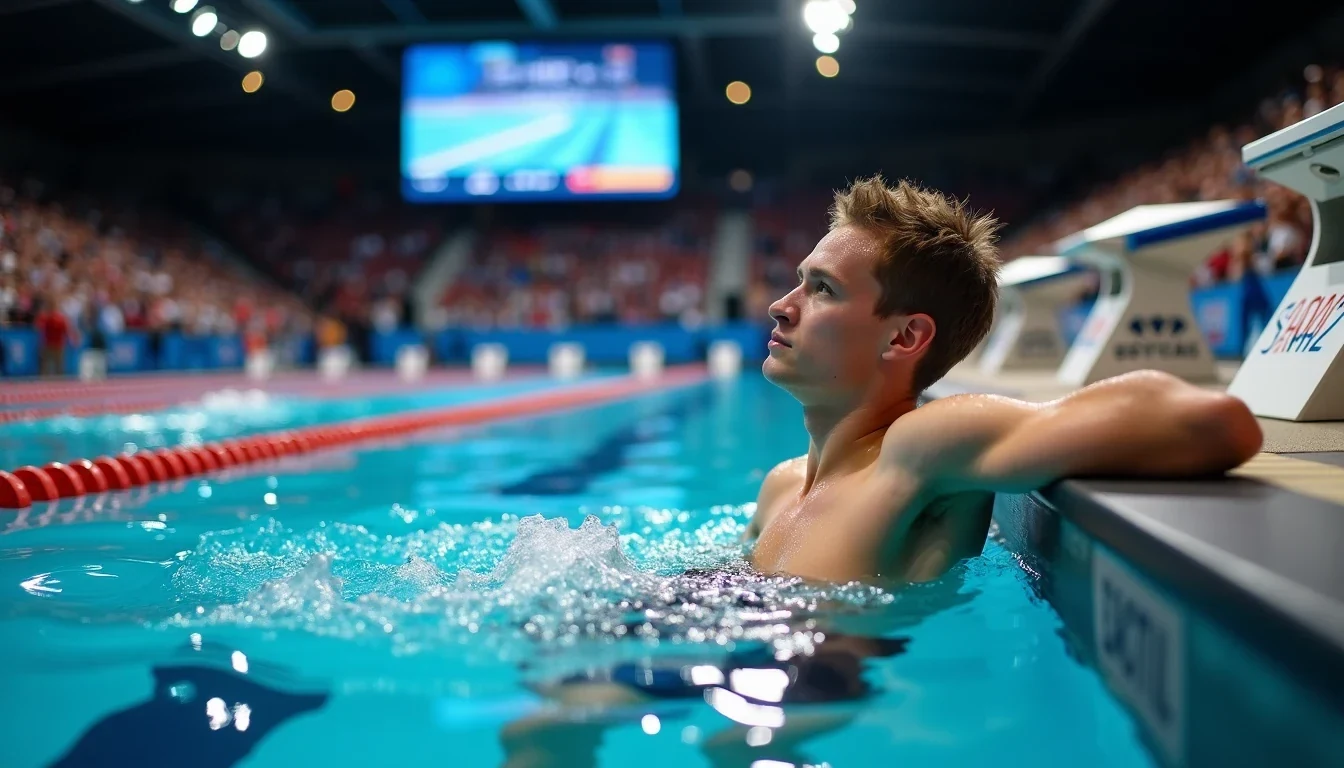
Eighteen-year-old Filip Nowacki, swimming for a territory of barely a hundred thousand residents, touched the wall in Glasgow at 2:07.87 and gave Jersey something new. It was a gold medal across any Commonwealth discipline for the first time in thirty-six years. He relegated an Olympic champion to bronze, grabbed silver over 100m, and left the Games as the most decorated athlete his island has ever produced. The only argument left is whether you just witnessed a heist or a coronation.
If you are chasing romance, a minnow nation just humbled two sporting superpowers with a combined population pushing seventy million. If you prefer the cold spreadsheet reading, a teenager who already owned both breaststroke distances at the 2025 World Junior Championships, had stacked four junior European titles, and seized the senior British 200m crown in April merely repeated what his results had been forecasting all year. Both versions are written in the same set of results. You simply choose which script you prefer.
The Glasgow Final
What actually happened
Nowacki entered the last night of breaststroke racing having already proved he could handle the pressure of a major championship pool. He had claimed second over 100m earlier in the programme, so nerves were clearly not an issue. The 200m demands a different kind of cruelty. It is four lengths of controlled aggression; going out too hard turns the final fifty metres into a battle against lactic acid rather than the other competitors. Nowacki paced it like a veteran. He turned at the hundred-metre mark in contention, then found another gear down the third length that left the field struggling to respond.
He stopped the clock at 2:07.87. Oliver Dawson of Canada, a swimmer who had shown strong podium form throughout the season, touched second in 2:08.39. The real eyebrow-raiser came behind him. Zac Stubblety-Cook, the Australian who holds an Olympic title over this exact distance and who arrived in Scotland as the definitive favourite, could only manage 2:08.91 and the bronze medal. For a man who had stood atop the Olympic podium in Tokyo, being out-touched by a teenager from a Channel Island famous for offshore finance rather than fast swimming represented a serious reversal.
That podium order tells its own story. An athlete representing a jurisdiction with no vast federal sports institute, no Olympic legacy pool programme stretching back decades, and a talent pool limited by sheer mathematics, sat above competitors from nations of forty million and twenty-six million respectively. The silver from the shorter event made Nowacki the most successful competitor Jersey has ever sent to these Games. No other athlete from the island has left a Commonwealth Games with two medals.
The Aftermath
The narrative around the result hardened into two camps before the medal was even around his neck. One side ran hard with the fairytale. The story practically wrote itself: a thirty-six-year gold drought ended by a teenager in a sport his territory had never conquered at this level, defeating an Olympic champion from a country that treats pool racing as a national birthright. It was the classic outsider template. A population of roughly a hundred thousand against two Commonwealth giants with centralised funding, high-performance centres, and talent identification programmes that hoover up prospects from coast to coast. In this telling, Nowacki was the plucky underdog who slipped through the cracks of the sporting establishment and stole the night.
The other camp, populated largely by those who had bothered to check the junior rankings or the domestic British circuit, treated the victory as a delayed introduction rather than a bolt from the blue. They pointed to the double triumph at the 2025 World Junior Championships, the haul of four junior European titles, and the senior British title taken in April. From that angle, Nowacki did not come from nowhere. He came from a junior career so dominant that the only genuine surprise was how thoroughly the mainstream had ignored it. The jersey on his back had kept him off the radar, not the stopwatch. His times had been elite for months. The flag simply made people assume he could not be serious until it was too late.
Underdog or Inevitable
The truth probably sits in the awkward middle, and this makes the performance genuinely compelling. Jersey does not have the centralised funding, the depth of qualified coaches, or the institutional machinery of Swimming Australia or Swimming Canada. Those structural disadvantages are real and affect every single day of a training cycle. Funding for travel, access to recovery facilities, and the simple statistical probability of finding a generational talent in a smaller population all work against an island programme.
Individual swimming is not rugby or cricket. One athlete, one coach, and one decent training block can produce a time that transcends borders in a way that team sports rarely allow. The pool does not care about your GDP or your population count. It cares about who moves through the water fastest on the night. Nowacki had the times on paper before he ever reached Scotland. The real upset was not the swim itself. It was the failure of the betting markets and the pundit class to price in a teenager who had already proven he could outswim senior fields at the British Championships. If you had been watching the junior circuit closely, this was not a shock. It was confirmation. If you were reading nationality instead of splits, you got burnt.
Junior world titles and senior national championships are not participation ribbons. They are leading indicators. Nowacki arrived in Glasgow with a resume that should have placed him on every shortlist. Instead, the shock narrative took over because the flag on his cap represented a hundred thousand people rather than twenty-six million. That is a failure of observation, not a miracle in the water.
Jersey will take either story. After thirty-six years without gold, they are not picky. But anyone who looked at the results from April already knew the kid was coming. The rest of us simply were not paying attention.