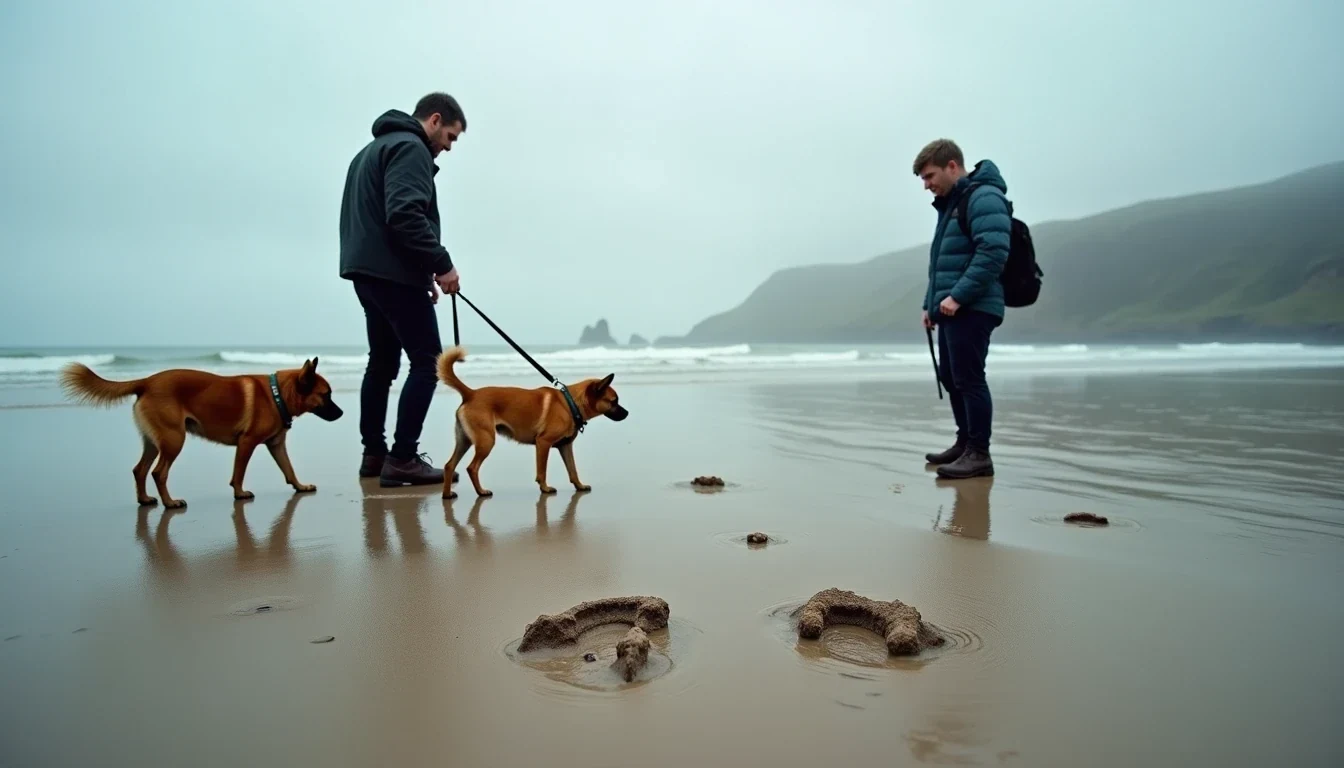
Two dog walkers on an eastern Scottish beach looked down and saw barefoot human feet pressed into stone, deer hooves beside them, the whole scene frozen mid-stride from roughly the time Rome was still figuring out concrete. The tide took it all back inside a week.
What Actually Happened
The couple had been out with their dogs on a stretch of coastline along the Firth of Forth when the prints emerged from beneath a thin skin of sand and silt. Archaeologists who arrived to document the scene identified semi-fossilised impressions from the late Iron Age, roughly 2,000 years old. Bare human feet. Deer. Other animals whose tracks interleaved with the human ones, all of them moving across what had once been marshland, long before anyone imagined their passage would outlast them.
The prints sat in an ancient peat bed, one of those layered time capsules that form when waterlogged vegetation stops decomposing. Normally these beds stay buried and protected. Storm surges and persistent wave action had stripped away the covering sediment, exposing the surface just long enough for the dog walkers to spot it and for word to reach professionals. Then the ordinary tidal cycle, the same one that revealed everything, scrubbed it clean again.
The archaeologists worked with photographs, measurements, rapid field recording. They could not remove the prints. Peat that old crumbles when disturbed, and the site itself was dissolving in real time. They saved data, not the object. The feet themselves are gone.
The Aftermath
Historic Environment Scotland confirmed the dating through stratigraphic context, the layer cake of sediment above and below the peat, and through comparison with other documented Iron Age coastal sites. No radiocarbon sample was needed once the surrounding geology told its story. The organisation has since logged the find in its rapid-response records, another entry in a growing file of heritage that appears and disappears faster than institutional timelines can accommodate.
The dog walkers have not been publicly named, which is standard for amateur finders in a country where detectorists and beachcombers routinely turn up material that professionals never would. Their role here was pure chance: the right low tide, the right angle of light, the decision to look down rather than at the horizon. Archaeologists openly acknowledge that most coastal heritage is found this way, by people who were not looking for it.
Several specialists quoted in coverage noted what these prints offer that a decorated pot or a corroded brooch cannot. A pot tells you someone made it, used it, maybe traded it. A footprint tells you someone stood exactly there, weight on the left foot, right foot lifting, probably cold, probably unaware that the ground would remember. The deer tracks add the fuller scene: human and animal sharing a landscape, not as metaphor but as simultaneous physical fact. The pot is evidence of culture. The footprint is evidence of a body.
The Social Media Problem
This brings up the part nobody quite agrees on. The dog walkers posted photographs. This is what people do. The images circulated quickly, drawing both professional attention and public curiosity. Archaeologists reached the site within days, which in bureaucratic terms is nearly instantaneous. They might not have known about the prints at all without that initial sharing.
The risk is equally obvious. Fragile coastal sites exposed on social media draw crowds before any protective assessment happens. Foot traffic on a peat bed destroys it faster than waves. There is no fence, no guard, no entry fee. The same mechanism that summons help also summons harm, and the timeline is compressed beyond the point where institutions can intervene meaningfully.
Historic Environment Scotland has not issued a specific policy statement on this find, but the broader tension is well recognised across UK coastal archaeology. The organisation’s rapid-response protocols are designed precisely because erosion is outpacing formal survey capacity. More prints are coming. More will vanish. The question is whether the next person who spots them posts first, calls first, or simply walks on to avoid becoming the reason the site gets trampled.
Some archaeologists have argued for closed reporting channels, direct lines to heritage bodies that bypass public platforms entirely. Others counter that amateur finders rarely know those channels exist, and that social media’s reach surfaces discoveries that would otherwise wash away unnoticed. Both positions are defensible. Neither solves the underlying arithmetic: more coastline is eroding, more heritage is emerging, and the institutions tasked with recording it are not growing proportionally.
The Firth of Forth prints are now a case study in that arithmetic. Two thousand years of preservation, a few days of visibility, a handful of photographs, and then the sea resumed its work. What survives is the record of having seen, which is not nothing, but is not the thing itself.
For the dog walkers, presumably, the memory of what their dogs led them to on an ordinary walk. For everyone else, the photographs, and the slight recalibration of what it means to stand on a beach knowing someone stood there before the calendar had a number that made sense to us.