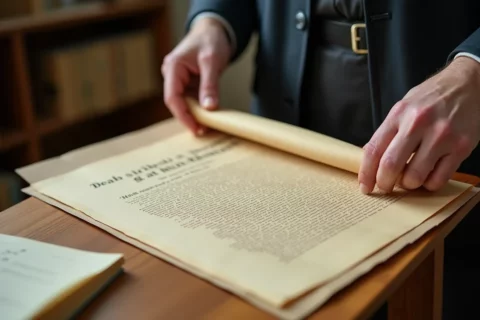

Charlotte Meyer was clearing out inherited family clutter when a folder she assumed held nothing but old letters turned out to contain 35 etchings by Rembrandt van Rijn. The prints had sat undisturbed for more than a century, assembled by her grandfather sometime between 1900 and 1920, then tucked away and forgotten through generations. This is the exact scenario that fuels late-night Reddit threads and fantasy daydreams: ordinary person, dusty attic, life-changing fortune. The reality that followed Meyer’s discovery proves far more complicated, and in many ways more interesting, than the viral headline version.
What Actually Happened
Meyer’s grandfather operated in a fundamentally different collecting era. When he acquired these 35 prints, Rembrandt etchings were not yet the heavily insured, climate-controlled, legally disputed assets they would become. He kept them in a family folder, a storage choice that suggests personal attachment rather than investment calculation. The collection spans portraits, biblical scenes, and self-portraits. Rembrandt treated these subjects as a genuine experimental frontier, not as secondary commercial work. He pushed etching technique further than any previous artist, manipulating line weight, shadow density, and plate surface to achieve effects painters struggled to match with brush and canvas.
The century of obscurity creates both opportunity and obstacle. Untouched collections bypass the forgery risks that plague works with murky intermediate ownership. However, that same silence means no exhibition history, no scholarly citations, and no prior authentication by recognized specialists. The folder preserved the physical objects but not the documentary trail that transforms found objects into marketable assets.
The Authentication Gauntlet
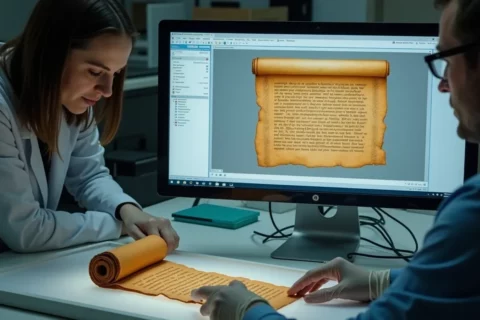
Determining whether these 35 prints carry genuine value requires navigating several technical layers, each with its own specialists and costs. First comes visual and stylistic analysis against established catalogues raisonnés, the comprehensive reference works that document every known state of Rembrandt’s printed output. Bartsch, Hind, and New Hollstein represent the standard scholarly frameworks. Matching a print to its documented state establishes the basic parameters of what the artist originally created versus what later hands altered.
Paper examination offers crucial dating evidence. Rembrandt worked with specific European mills, and watermarks like the Fool’s Cap or Strasbourg Lily can anchor a print to a particular production window. Chain lines and laid lines, the subtle texture patterns from hand-made paper molds, provide additional chronological anchoring. A print on machine-made paper or with a watermark first documented decades after Rembrandt’s 1669 death immediately signals later production.
The impression quality itself tells stories the naked eye can miss without training. Early impressions pulled during Rembrandt’s lifetime or shortly after retain crisp line definition, rich tonal variation, and often visible burr, that velvety ink accumulation where the plate held extra material. Later impressions from worn plates flatten out, losing subtle gradations. Restrikes, pulled centuries later from damaged or re-etched plates, can show entirely alien line work where later owners tried to revive exhausted copper.
Ink analysis through X-ray fluorescence or Raman spectroscopy remains available for contested cases, although its invasive nature limits routine application. The core challenge for Meyer’s collection is distinguishing original plate impressions, potentially worth millions depending on subject and condition, from later restrikes that might fetch only hundreds or low thousands.
The Provenance Problem
Ownership history functions as the connective tissue between physical object and market confidence. For Meyer’s prints, provenance begins with family oral tradition and whatever documentary traces her grandfather left behind. Sales receipts, auction catalogues, letters mentioning acquisitions, or even old photographs showing the collection in situ would strengthen the narrative chain. Without these, specialists face the slow work of reconstructing plausible pathways through archival research and comparative analysis.
Gaps in provenance carry particular risk for works with European origins. Wartime looting, forced sales, and border shifts across the early twentieth century created entire categories of legally toxic art. A clear ownership trail from 1900-1920 acquisition through to Meyer’s recent discovery would neutralize these concerns. Absent that clarity, legal due diligence becomes its own expensive parallel track, potentially requiring specialist researchers and extended timeline before any sale could proceed.
The financial architecture of authentication stacks quickly. Print specialists charge hundreds to thousands per work for initial assessment. Conservation needs after a century of folder storage—cleaning, flattening, tear repair, foxing remediation—run to thousands more per print. Insurance for transit and storage, climate-controlled facilities, and specialized art handlers for movement all consume capital before any revenue materializes. A 35-print collection could easily demand mid-five-figures merely to reach confident valuation, with no guarantee of corresponding market value.
The Aftermath
The stronger human story may be her grandfather’s quiet decades of assembly, not Meyer’s discovery moment. He collected before the art market institutionalized, before families fought inheritance battles over insured prints, before authentication disputes generated their own legal specialty. His folder storage reads as almost willfully modest, a collector who valued proximity over display, personal encounter over market validation.
Contemporary collecting has largely lost this register. The modern art market converts aesthetic experience into asset class with ruthless efficiency. The grandfather’s approach, whether through temperament or historical timing, resisted that conversion. His collection survived precisely because it was not treated as wealth requiring protection, though that same casualness now complicates his granddaughter’s efforts to realize whatever value exists.
Meyer’s situation embodies a recurring tension in cultural economics. The fantasy of discovered treasure assumes immediate liquidity, but specialized markets operate on timelines and verification standards that contradict viral moment expectations. The folder that preserved these prints for a century now requires professional infrastructure to unlock. This infrastructure demands patience, capital, and tolerance for uncertainty.
Whether the 35 etchings ultimately justify that investment depends on answers not yet available: original impressions or restrikes, early states or late, documented provenance or reconstructed speculation. The dream of attic fortune meets the grinding particularity of art world expertise. For every genuine discovery that clears every hurdle, countless hopeful finds collapse at one authentication stage or another. Meyer’s grandfather never had to navigate this machinery. His granddaughter cannot avoid it.