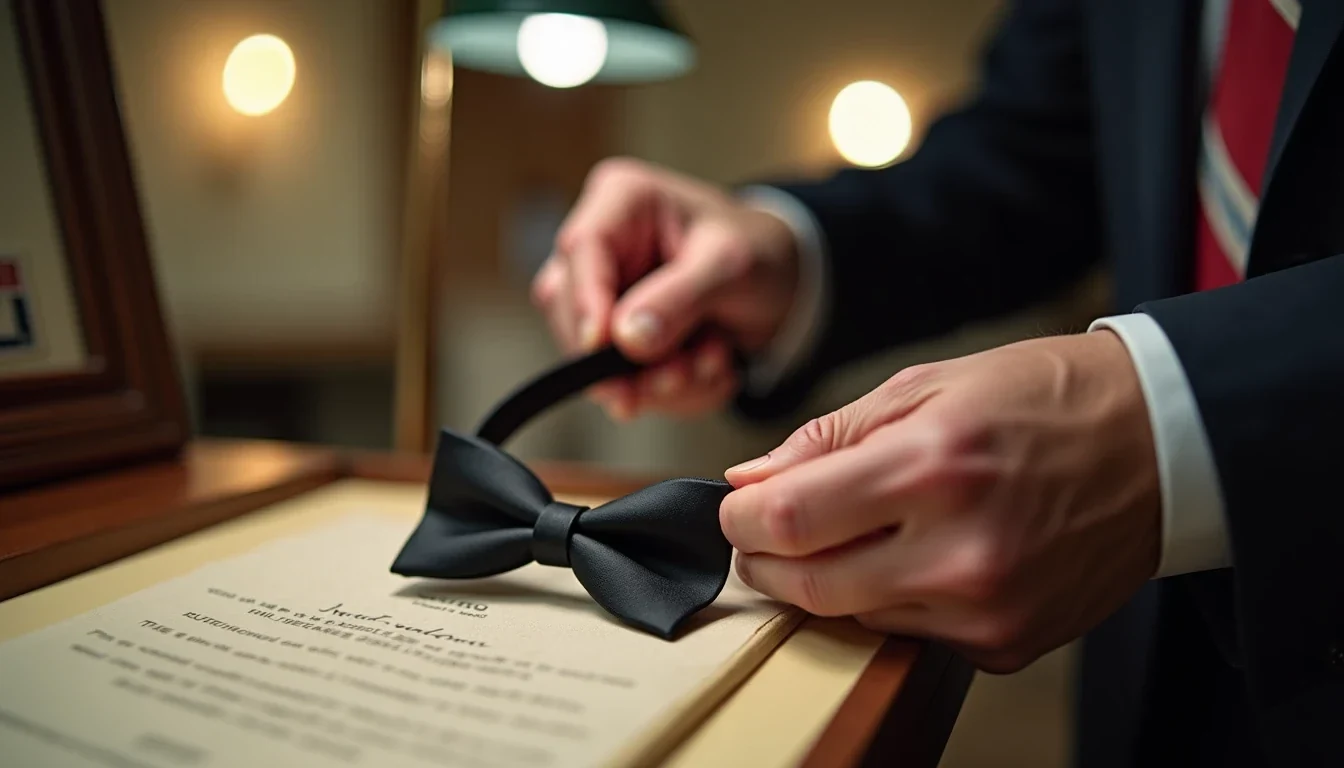
A piece of black string tied into a bow just sold for $185,000. You could buy functionally the same thing for thirty bucks at any department store. The price difference came from whose neck it used to circle: Harland Sanders, the Kentucky Fried Chicken founder who turned himself into a human logo and kept cashing the checks long after he’d sold the actual restaurants.
Heritage Auctions ran the sale in 2026, moving 27 lots from the Sanders family estate that pulled $1.2 million total. The bow tie hammered at more than double its high estimate of $80,000. A handwritten planner from 1978-1979 went for $110,000 against a $40,000-$60,000 projection. Even a pair of prescription eyeglasses, the kind of item most families toss in a drawer, fetched $75,000. The crown jewel was Sanders’ original white linen suit jacket at $320,000. These were prices for proximity, not garments.
What Actually Happened
The provenance chain runs straight from Sanders’ death in 1980 through his daughter Margaret Sanders Ruggles and her heirs. Family affidavits, notarized statements, and archival photographs backstop every item. The bow tie carries a faint embroidered “H.S.” on its reverse. The planner’s leather cover bears the same initials. Heritage Auctions, which built its reputation on celebrity and historical memorabilia, took the consignment in late 2025 and watched competitive bidding do the rest.
The numbers tell a stark story about what collectors are actually buying. A standard fabric bow tie retails for $20-50. The Sanders premium clocks in at roughly 3,700 times intrinsic value. The planner, maybe $15-30 empty, sold for enough to buy a decent house in some markets. This is not rational utility pricing; it is the economics of recognition, where the silhouette matters more than the substance.
The Aftermath
The planner’s contents reveal the gap between the grandfatherly mascot and the man who wore the costume. Sanders was 88 when he filled those pages, still flying to franchise openings, still checking on operations, still furious about gravy he considered an insult to his name. “Gravy still thin, no flavor!” reads one entry. “Potatoes like paste. They ruin my good name.” Another line, “Tired, but work must go on,” lands differently when you remember this was a man who’d already sold the company and could have been fishing.
That sale came in 1964 for $2 million plus a lifetime salary, to investors including future Kentucky governor John Y. Brown Jr. Sanders kept appearing in commercials, kept wearing the white suit, kept being Colonel Sanders. He never stopped criticizing what KFC became. He called the gravy “slop” and the mashed potatoes “wallpaper paste.” In 1974 he sued the company for $122 million over use of his image to promote a “Crispy Colonel” product line he wanted nothing to do with. The benevolent face on the bucket was legally at war with the brand it sold.
Before any of this, Sanders’ resume read like someone trying to lose money deliberately. He was a steamboat pilot, railroad fireman, farmer, tire salesman, service station operator, and midwife. His first food operation was a dining room in the back of a Corbin, Kentucky gas station in 1930. He didn’t franchise until 62, after Interstate 75 bypassed his original location and left him with nothing but a recipe and a pressure cooker. The polished origin story of American entrepreneurship started as a desperation move by a man most would have considered past retirement age.
What Buyers Actually Own
The auction raises a question that won’t fit on a certificate of authenticity. Is the $185,000 bow tie a piece of American history, a fragment of corporate mythology, or literally a prop from one of advertising’s longest-running performances? The uncomfortable answer is probably all three, and the buyers know it.
KFC operates in 145 countries with over 29,000 locations. Sanders’ face is among the most recognized on earth, often by people who couldn’t name the state of Kentucky let alone the man’s actual biography. The money buys that recognition, not fabric or craftsmanship. It buys the chance to own something that touched the body that touched the brand.
The family held these items for decades. The decision to sell now suggests something about how generational memory works, or doesn’t. Margaret Sanders Ruggles preserved her father’s effects meticulously. Her heirs looked at the same collection and saw liquidity. There’s no moral failure there, just the ordinary math of inheritance meeting a market that prices nostalgia by the square inch of recognition.
Sanders himself understood the performance aspect. He kept wearing the suit, kept dying the goatee, kept playing Colonel Sanders even while publicly trashing the product. The planner entries about Japan expansion meetings and competitor observations show a businessman still engaged, still calculating. But the entries about ruined gravy show something else, something harder to monetize: a founder who sold his name and spent the rest of his life arguing with what it became.
The white suit jacket at $320,000 makes a certain sense as the centerpiece. It’s the complete costume. The bow tie, the glasses, the lighter at $45,000, these are fragments, souvenirs of a person who gradually became a logo. Someone will display that tie in a climate-controlled case and tell visitors it cost as much as a Porsche. They won’t be able to explain what the auction catalog doesn’t fully capture: whether they’re looking at history or marketing material that escaped containment.
Heritage Auctions doesn’t have a category for that ambiguity. Neither do the collectors who drove the final prices. What they bought was real, verified, documented. What it means beyond the hammer price remains unsold, maybe unsellable, sitting in the same display case with no reserve.