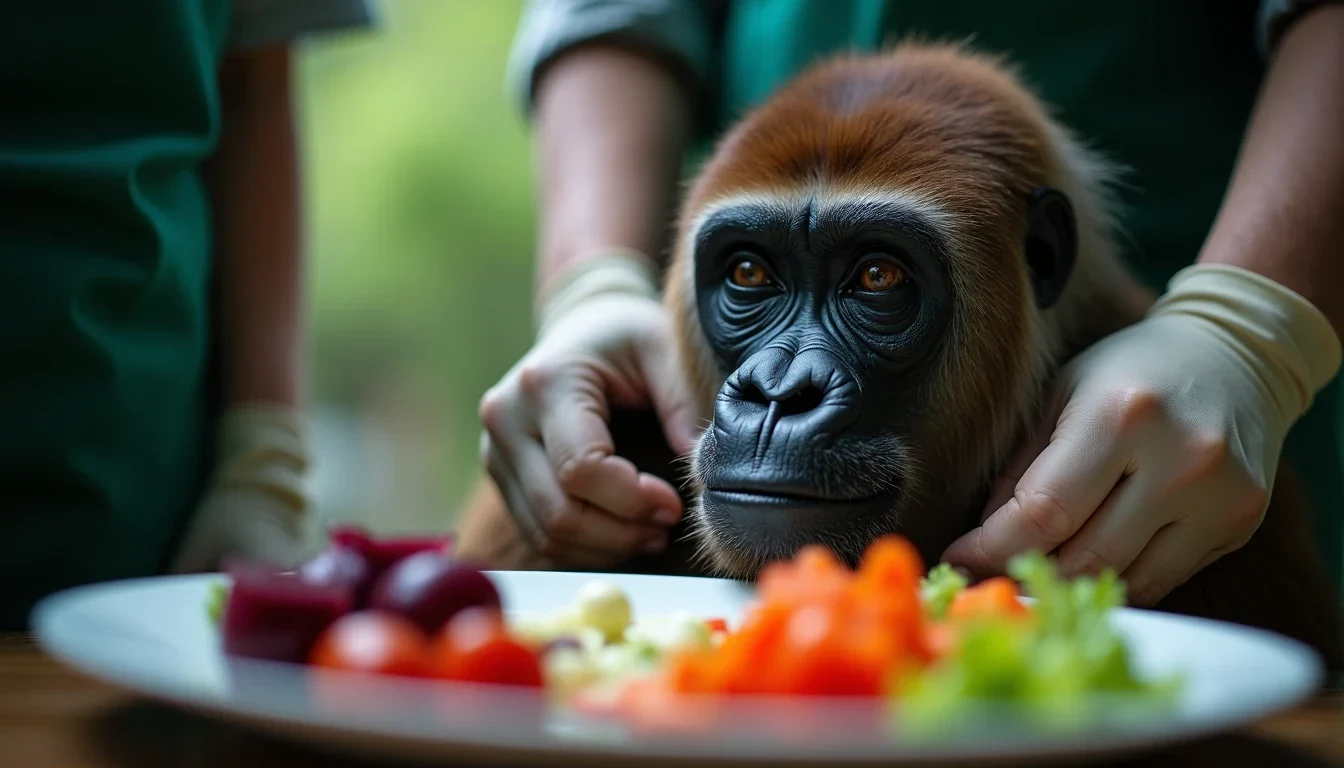
Fatou turned 69 on April 13, 2026, and her keepers at Berlin Zoo served her cherry tomatoes, beetroot, leeks, and lettuce. No grand spectacle, no crowd-pleasing cake. Just soft vegetables prepared by hand. This Western lowland gorilla, the oldest on record in human care, lost her teeth around age 60. The meal was practical, almost mundane, and that makes the moment land. You do not reach 69 as a gorilla by accident. You get there because someone spent 67 years adjusting the menu.
What actually happened
The birthday spread was not the story Berlin Zoo would have preferred to tell. In her younger years, Fatou drew visitors with the full primate repertoire: foraging, displaying, interacting with her group. Now the staff chop her food small enough to swallow without chewing. The 2026 celebration was documented, shared, and promptly circulated beyond the usual zoo-watching corners of the internet. People who have never set foot in Berlin now know her name.
Fatou arrived at the zoo in 1959, a two-year-old estimated from her size and dental development at intake. No birth certificate accompanied her. Paperwork from that era, when zoos acquired wild-caught animals through channels that blurred into the exotic pet trade, was rarely precise. Her origin story carries the details that survive: captured in West Africa, purchased by a French sailor, allegedly used to settle a tavern debt in Marseille. Whether that last part is folklore or documented fact hardly matters now. Someone in 1959 looked at a young gorilla and guessed her age correctly enough that the count still holds up in 2026.
The zoo has tracked her from that estimate for over six and a half decades. Her birth year sits at approximately 1957. The margin is small, a year or two in either direction, but it exists. For an animal whose entire claim to record-breaking status rests on that initial guess, the uncertainty is worth considering alongside the achievement.
How she outlived every expectation
Fatou’s longevity rests on three pillars that wild gorillas simply do not access. The first is veterinary intervention. Regular examinations monitor her joints, organs, and vital signs. Problems get caught before they become crises. The second is diet management. Tooth loss in old age would kill a wild gorilla; in Berlin, it means the kitchen staff prepare cooked vegetables, fruits, and nutrient mashes. The third is environmental control. No predators, no food scarcity, no exposure, no competition for shelter. Her stress levels are managed by routine.
The contrast with wild populations is brutal. A gorilla in the forests of Central Africa typically dies between 30 and 40. Push past 45 and you are witnessing something rare. Fatou at 69 is not merely exceptional; she is nearly double the upper wild estimate. Researchers tracking wild gorillas spend decades in dense forest, identifying individuals by nose prints and facial scars, recording births when they can observe them directly, collecting fecal samples for DNA analysis. The work is painstaking and the data incomplete. Many wild gorillas die uncounted. Comparing Fatou’s documented 69 years and a wild lifespan reveals a gap in what we can even know.
The record and what it cannot say
Fatou’s age validates decades of care at Berlin Zoo. It also creates a temptation that should be resisted. One outlier does not redefine a species. Presenting her as proof of what gorillas can achieve would misrepresent the reality for wild populations facing habitat loss, poaching, and disease. Her story is better read as a demonstration of what institutional commitment can accomplish for an individual, not as a benchmark for the biology of Gorilla gorilla gorilla.
The uncertainty in her own record reinforces this. Zoo documentation from 1959 was not designed for 21st-century scrutiny. The estimate of her age at arrival was professional and careful, but it was still an estimate. If she was slightly older or younger than assumed, the record shifts. The zoo has been transparent about this, which is more than can be said for many historical animal records.
The aftermath
Fatou’s 2026 birthday generated the predictable cycle: zoo posts images, social media amplifies, news outlets aggregate, commentators weigh in on longevity science or animal welfare or both. The gorilla herself, presumably, ate her vegetables and slept. There is no indication she understood the occasion, which may be the most honest aspect of the entire event.
The keepers who prepared her meal have spent careers with her. The zoo’s investment in her care spans generations of staff. That continuity is a factor in her survival. Gorillas are not machines that run on correct inputs. They need stable social environments, recognition of individual temperament, and adjustments as conditions change. Fatou has had handlers who knew her preferences, her limits, and her history.
What comes next is the harder question. Gorillas do not live forever, and 69 is already so far beyond expectation that each additional year is uncharted. The zoo will continue adapting her care, softening her food further, monitoring more closely, making the small adjustments that accumulated into this record. At some point the record will end. The number will stand, the uncertainty will remain, and the contrast with wild lives will still be there to interpret.
For now, she eats her vegetables in Berlin, and the internet watches.