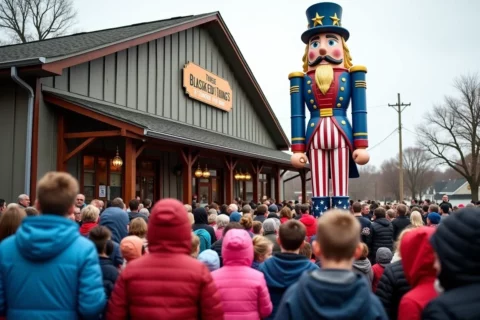
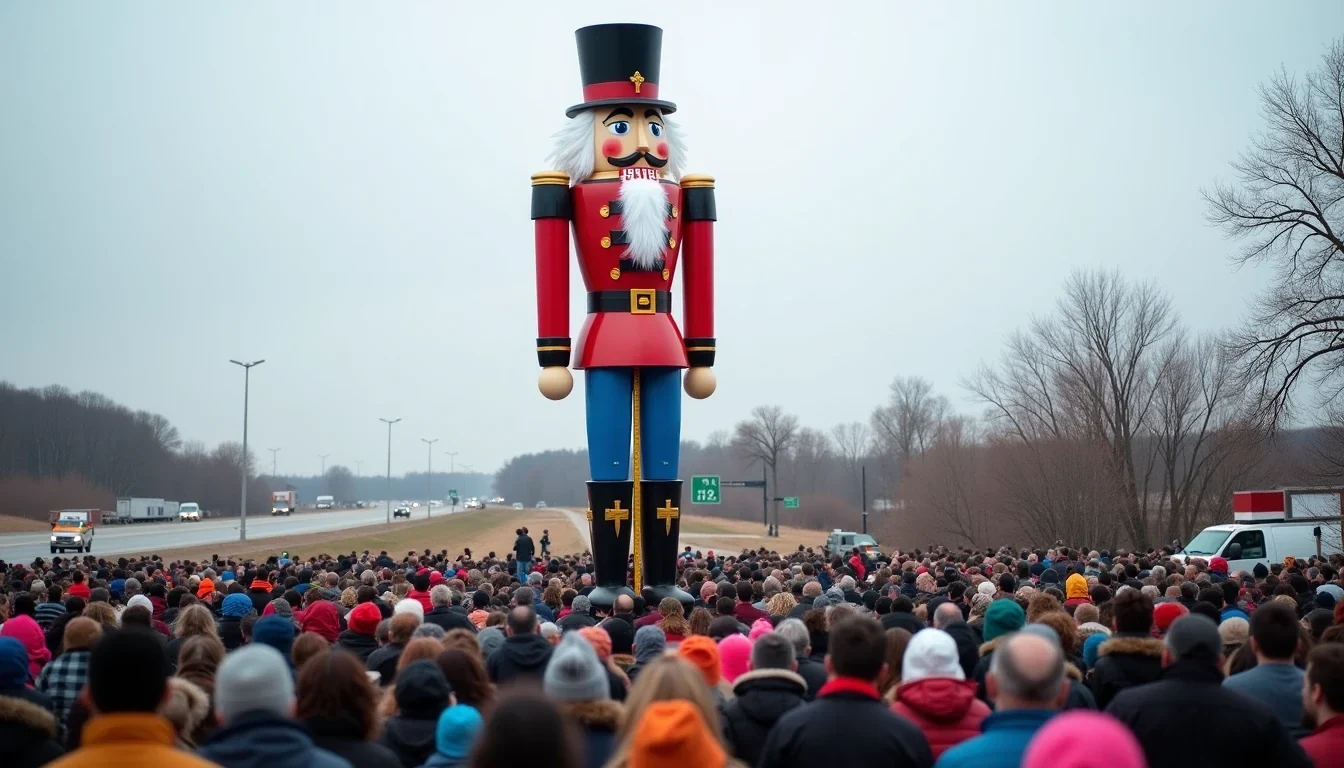
Luverne put a 65-foot nutcracker on a pedestal and, almost by accident, turned a private grief collection into a roadside money machine. Verne the Patriot now looms outside Those Blasted Things, his Uncle Sam face built for speed, spectacle, and the kind of photo that gets sent to three group chats before lunch.
The town took a hobby that started in loss, scaled it until drivers on Interstate 90 could spot the hat first, and then watched the foot traffic follow. That is either smart rural economic development with a sense of humor or a giant fiberglass shortcut to fame. In Luverne, it is doing both jobs at once.
What actually happened
Verne the Patriot was unveiled in July outside the rock shop in Luverne, Minnesota. Hundreds showed up for the reveal and got the full small-town pageant treatment: patriotic cookies, slushies, and the final measurement announced in public like a prize fight weigh-in. The numbers are absurd on purpose. Verne stands 65 feet 7½ inches tall on a 9-foot pedestal, which puts him close to 75 feet in the air once the base is counted. He is nearly twice the height of the current Guinness World Records holder, a 33-foot nutcracker in Germany.
The word “working” gives the whole thing its edge. Verne is not just a decorative giant with a face and a flag theme. He has a jaw that is meant to do the nutcracker thing, which makes the record claim interesting. Scale is the easy part. Function is where the argument starts. If the jaw opens and closes and can crack a nut, the record makes sense. If Guinness decides the mechanism needs to meet a stricter standard than “it looks like it should work if you trust the engineering,” then the town has built a very expensive selfie magnet with paperwork attached.
Luverne already had the ingredients for this kind of stunt, except they were not really a stunt. Betty Mann, now 96, began collecting nutcrackers after losing her husband and daughter. What started as a way to carry something heavy turned into a local obsession, then a town identity, then a public oddity with enough momentum to become civic branding. Luverne eventually ended up with more nutcrackers than residents, which is the kind of line that sounds made up until you realize someone had to count them.
The Aftermath
The business side has been blunt. Since the July unveiling, Those Blasted Things has reportedly quadrupled customer traffic. That is not a soft lift or a nice little bump; it is a traffic jam in shop form. The spillover has also pushed people toward neighboring businesses. A single roadside object starts acting like a tiny economic weather system.
Towns chase these giant landmarks because they do one job extremely well: they stop a car. Stopping a car is the first and hardest battle in rural tourism, because a driver passing through can miss a whole town without meaning to. Verne fixes that problem in the most direct way possible. He is visible from a distance, he is ridiculous in scale, and he gives travelers a reason to pull off, snap a picture, and wander inside for something cold, sweet, or shiny. In a place trying to convert highway motion into local spending, that is a significant win.
The cleaner reading is that Luverne has done what a lot of towns try to do and most fail at: take one weird local thing and stretch it into a brand people can repeat in a sentence. The risky reading is that the town has built its tourist identity around one giant object and a lot of faith. That can work for a while. It can even work well. But once the novelty thins out, a town still has to answer the basic question: do people come back after the first photo?
A private obsession became public property
Betty Mann’s collection is the real origin story here, and it keeps the whole project from feeling like empty roadside nonsense. This did not begin with a marketing meeting. It began with a woman grieving two family losses and filling her space with nutcrackers until the collection became impossible to ignore. Towns do not always invent their identities from scratch. Sometimes they inherit them from one person’s odd, stubborn habit and then decide to build around it.
That is the clever part of Luverne’s move. It did not choose a generic mascot or a safe civic symbol. It doubled down on something already real, then made it impossible to overlook. The new figure turns the town’s private story into public infrastructure. Passersby do not need a brochure to understand the pitch. They see the hat before they see much else.
The record claim is the catch
The whole project hangs on a technical point that is pure roadside Americana. Guinness records are tidy until someone tries to build one in fiberglass and patriot paint. Verne is almost twice the size of the current record holder, but Guinness does not award points for being hilarious, tall, or visible from space. The category has to be satisfied on its own terms.
That leaves Luverne in a good position and a cheeky one. Best case, it gets the title and owns one of the strangest bragging rights in the country. Worst case, it still ends up with a giant Uncle Sam nutcracker pulling traffic off the road and into town. Either way, the result is the same. One person’s private collection has become a public landmark, and a town that used to have to explain itself can now simply point to the giant hat in the sky.