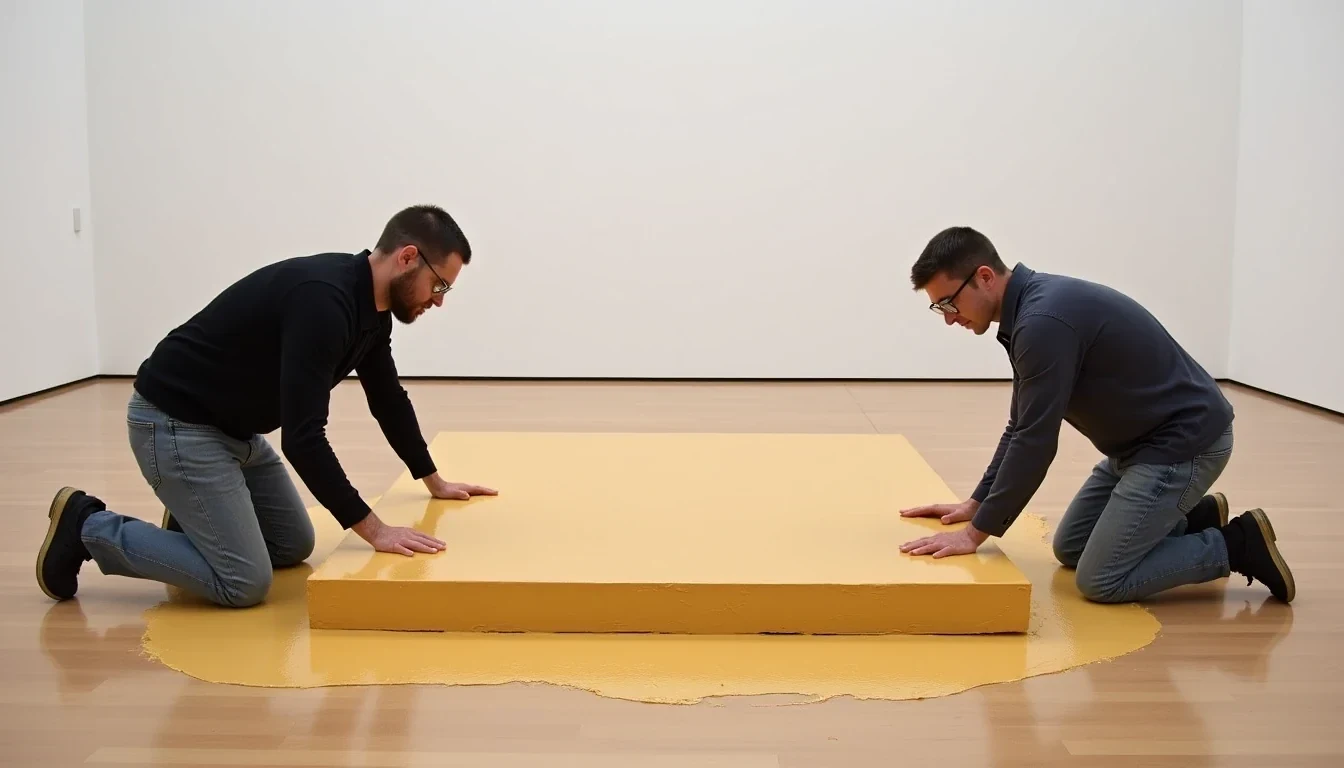
Rotterdam has a new argument sitting on the floor, and it smells like lunch. Museum Boijmans Van Beuningen has rebuilt Wim T. Schippers’ notorious Peanut-Butter Platform using more than 800 pounds of the spread, enough for roughly 15,000 sandwiches, and then asked visitors to stare at it as if the question were still open. Of course it is open. That is the whole point. You look at a smooth brown gallery floor and half the room sees conceptual art, while the other half sees a catering disaster with better lighting.
Schippers knew exactly what kind of trouble he was making. He developed the work in the 1960s, when Dutch art was already being shaken by people who wanted to kick the pedestal out from under it. His trick was brutal in its simplicity: take something common, bulky, and faintly ridiculous, then force a serious institution to treat it like an object worth guarding. That tension has not aged out; it has only become easier to post.
What actually happened
The museum did not just dump peanut butter on the floor and call it a tribute. Two installers shaped the whole thing by hand into a low, smooth platform, which makes the joke sharper. The final piece looks almost careless from a distance, but it took a lot of unglamorous labor to make it look like nothing happened.
That is the real trick with this installation. Peanut butter sounds simple until you have to work with it at gallery scale. Oil starts to separate, texture shifts with temperature, and dust lands on it and stays there. Everything about the material pushes against the clean, preserved museum fantasy people usually expect from modern art. Instead of bronze, marble, or canvas, you get an edible spread that has to be managed like a temperamental living thing.
The museum also put barriers around it so nobody would wander in and ruin the surface with a shoe print. That sounds obvious until you remember what kind of work this is. A piece that invites close attention also invites a test of boundaries, and this one is basically a magnet for curiosity. The safest way to protect a floor made of peanut butter is to tell people they cannot touch the floor made of peanut butter.
Then there is the smell, which nobody pretends is irrelevant. A gallery full of 800 pounds of peanut butter is a sensory takeover. The museum had to handle that while keeping the room presentable and the installation intact. The whole setup turns maintenance into part of the performance, even if no one bought a ticket to watch staff fight the weather, the dust, and the urge of every visitor to lean in just one step too far.
The restaurant menu joined in too. The museum added a peanut-butter sandwich during the exhibition run, which makes people either laugh or roll their eyes hard enough to qualify as cardio. It also works. Once the food leaves the plate and enters the gallery, the joke changes shape. You stop seeing peanut butter as an ordinary snack and start seeing it as a material that can swallow a room.
The Aftermath
The argument is almost too easy to predict, which is why it keeps working. One camp sees a clever reset of the ordinary. Peanut butter usually belongs in a jar, on toast, or in a lunchbox. Put it across a museum floor and it gets strange fast. The scale does the heavy lifting. A substance people know by taste suddenly becomes something people have to think about, and the shift is immediate.
The other camp thinks the museum has spent time, money, and staff energy recreating the aftermath of a kitchen accident. That reaction is not a failure of the work; it is the work. Schippers built his reputation by rejecting the idea that art needs noble materials, a permanent body, or some neat little message attached to the frame. If your first response is disbelief, the piece has already done its job.
That split reaction says more about museums than it does about peanut butter. A museum is usually a place where objects are protected because they are old, rare, or expensive. Schippers turns that expectation inside out. His platform is perishable, awkward, and stubbornly ordinary. It forces the institution to spend real effort preserving something that looks like it should be scooped up and wiped away. The irony is obvious, but it is not cheap irony. It takes planning, staff time, and a willingness to let visitors feel slightly ridiculous for asking whether a floor can count as art.
The revived work lands now as well as it did decades ago because social media loves a clean visual and a clean argument, and this installation hands over both. You get the picture in one glance. Then you get the fight in the comments. People can call it genius, nonsense, or both in the same sentence, and the piece still wins because it turns reaction into part of the exhibit.
The funniest part is also the most honest. The object itself looks almost effortless. The reality behind it is not effortless at all. Someone had to acquire the peanut butter, move it, shape it, guard it, clean around it, and keep it from turning into a sticky ruin. The art is partly in the idea, but the labor is right there too, hiding in plain sight under a layer of something you would normally spread on bread.