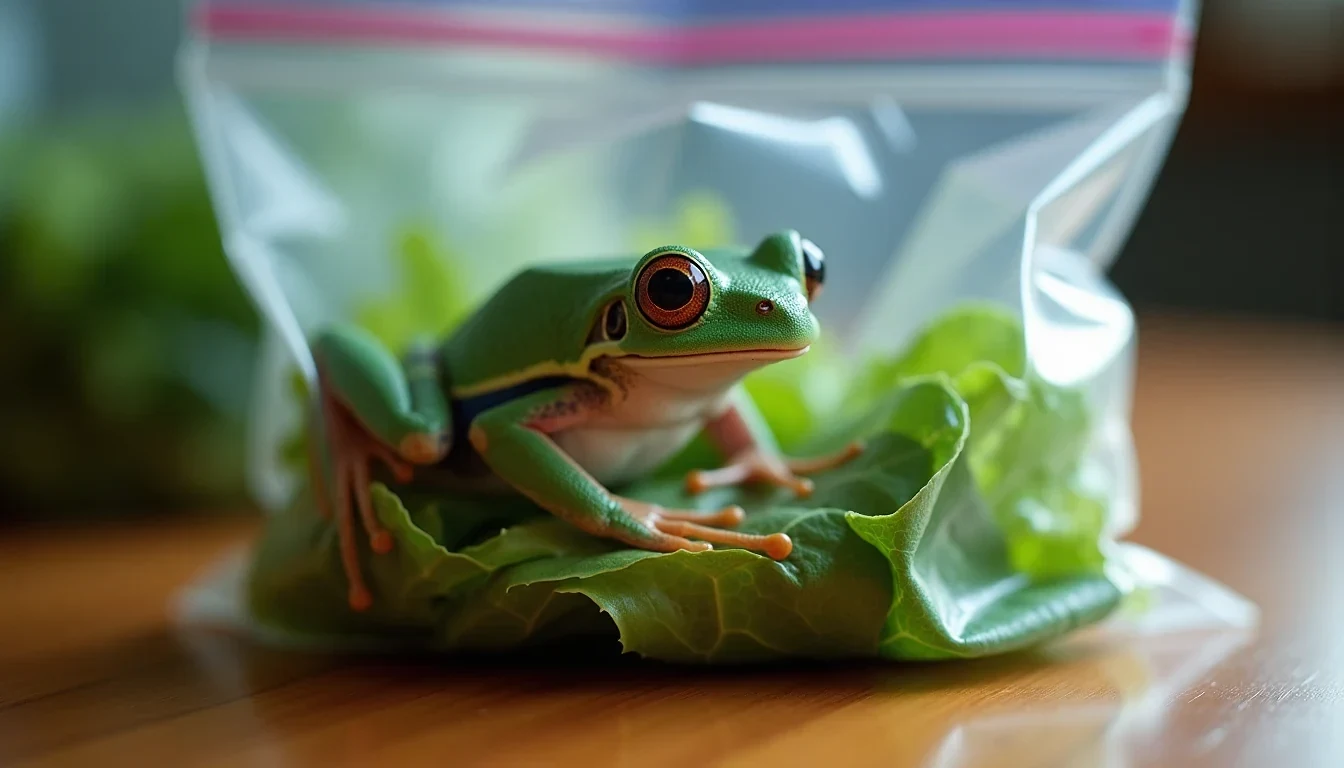
A sealed bag of Woolworths salad sat in the fridge of a Western Australia farmhouse until Rhys Smoker, an Esperance farmer, tore it open for dinner. What flopped out was not limp rocket or a stray twig. His housemates called it a setup. Then the thing blinked. A live Peron’s Tree Frog, emerald spots and all, had ridden the entire industrial food chain from field to fluorescent-lit shelf and come out the other side still breathing.
What Actually Happened
Rhys Smoker bought the salad bag from his local Woolworths, a routine shop in a town of roughly 13,000 people on the southern coast of Western Australia. The bag went into his refrigerator. When he opened it, the frog was already inside, sealed behind the plastic with the mixed leaves.
His housemates refused to believe him. They assumed someone had planted it, a gag for social media clout. That theory collapsed when the frog moved on camera. Smoker filmed and photographed the animal in situ, the sealed packaging still intact, the creature visibly alive and unbothered by its audience. The footage traveled.
The species, Litoria peronii, is native to eastern Australia, not Western Australia. Esperance sits thousands of kilometers from the frog’s natural range. Either the salad greens were grown or packed on the east coast and shipped across the continent, or the frog hitched a ride through an even more convoluted path. Either way, the sealed bag was genuine. The frog had not been inserted after purchase. It had survived every checkpoint the modern food system throws at fresh produce.
Smoker’s response was softer than the supply chain that carried the animal. He extracted the frog carefully and released it into his garden, a small act of restitution after an ordeal no amphibian could have anticipated.
How the Frog Outlasted the Cold Chain
The industrial journey from farm to supermarket shelf is not designed for passenger survival. Harvesting involves mechanical cutters or manual pickers, both of which should dislodge stowaways. Washing baths use chilled water, sometimes with sanitizers. Optical sorters scan for defects and foreign objects. Packaging seals the product in modified atmosphere or standard plastic. Refrigeration holds the bag between 0°C and 4°C. Distribution trucks maintain that cold. Shelf display keeps it there until purchase.
A frog should not survive this. Yet Litoria peronii did, and its biology explains part of how.
Amphibians enter torpor or brumation when temperatures drop. Metabolism slows to a fraction of normal function. Oxygen demand plummets. The frog essentially waits, dormant, while the world moves around it. The salad bag’s cold chain did not kill it. The cold chain may have saved it, suppressing its needs until a farmer’s kitchen warmed it back to activity.
Size and camouflage mattered too. A small frog tucked into dense leaf matter could evade visual inspection, particularly if sorting lines move at commercial speed. The washing process, designed to remove soil and microbes, might not dislodge an animal clinging to a stem. Packaging machinery seals bags in seconds. Once inside, the frog had shelter, humidity from the leaves, and a temperature that kept its systems on minimal power.
Whether this reveals gentle processing or a gap in inspection depends on your framing. The system did not detect the frog. It also did not kill the frog. These two facts are not contradictory, but they point in different directions. A harder wash, a more aggressive sort, a slower inspection line, might have caught or destroyed the animal. The same conditions that let it slip through also let it live.
The Aftermath
Woolworths issued the statement corporations issue in these moments: food quality and safety were taken seriously, and an investigation was underway. The language is standard because the situation is not. A live vertebrate in sealed produce is rare enough to become news, common enough that comparable cases stack up if you look.
In 2017, a Sydney shopper found a live green tree frog in a sealed Coles spinach bag. In 2019, a UK family unpacked a live lizard from Tesco organic bananas. Spiders, including venomous species, surface periodically in imported grapes and bananas. Each incident follows the same arc: disbelief, documentation, corporate response, public fascination.
The pattern suggests something the industry does not advertise: no inspection system is total. Optical sorters read color and shape, not intention. Human inspectors work at speed. Washing removes surface contaminants, not passengers with grip. The longer and more complex the supply chain, the more entry points exist for the natural world to reassert itself.
Rhys Smoker’s frog became a minor internet fixture because the image is undeniable: a wild animal, alive, behind the plastic we trust to separate nature from our food. The disgust reaction is automatic. A frog in salad is contamination. The biological feat is harder to dismiss. This was not a dead specimen, a smear of bacteria, a statistical risk. This was an individual that endured harvesting, washing, packing, refrigeration, interstate transport, retail display, and a farmer’s fridge, then walked away into a garden.
Woolworths will tighten whatever protocol failed, or say they have. Smoker will buy salad again, probably checking the bag first. The frog, if it survived the garden transition, will not know it was ever famous. The system will keep moving, fast and cold, and somewhere in the next harvest, another small creature might be holding on, waiting to see who opens the bag.