
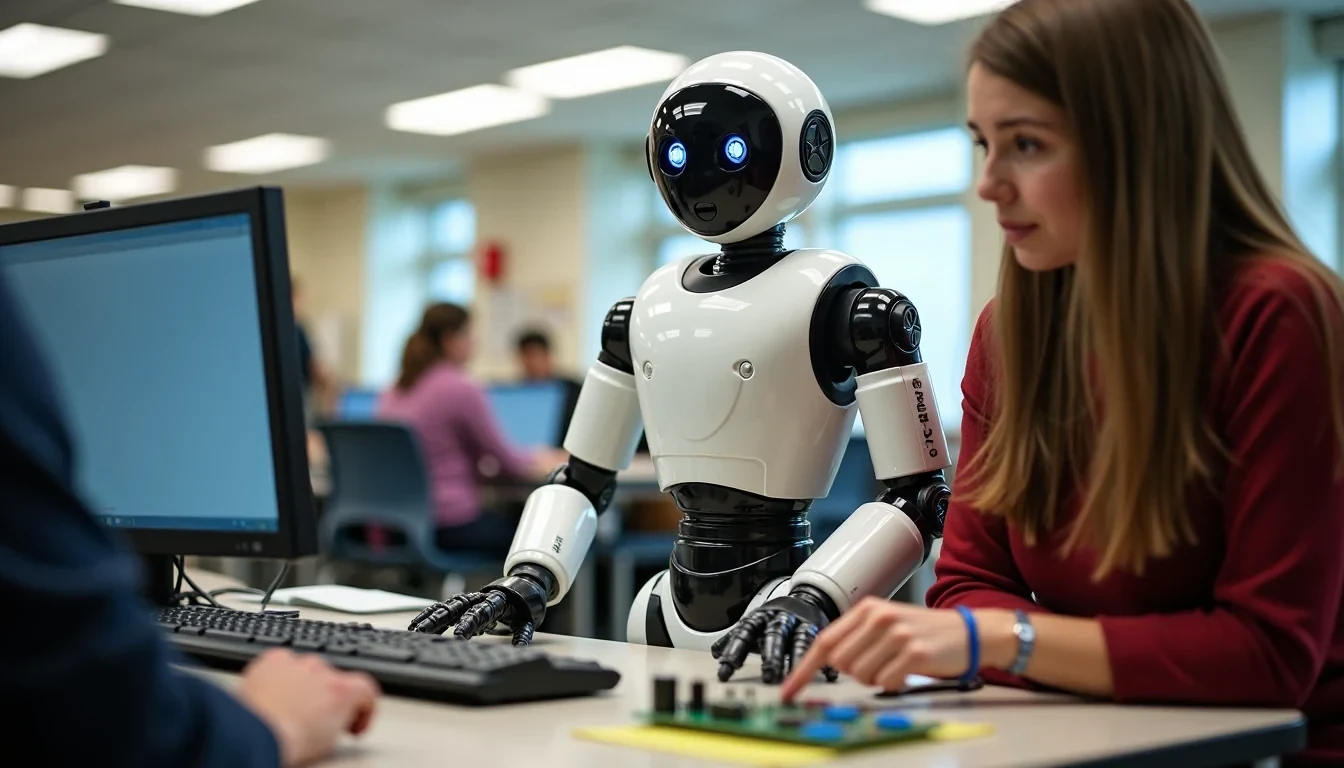
A rural New York school district bought a $60,000 robot to help kids with robotics. The biggest fight is not about the price tag, but about who sees the data, what the machine learns about students, and why a school needs a life-sized humanoid when its maker also sells AI sex dolls.
Salamanca City Central School District spent nearly $60,000 on a Realbotix robot nicknamed Sally. The machine was intended as a technical assistant for the robotics program, answering questions about Arduino boards, demonstrating humanoid system maintenance, and giving a small district access to hardware usually found in big-city labs. Then, questions grew louder.
What actually happened
Sally is a stationary humanoid built for the high school robotics program, not a roaming classroom robot. Its job, on paper, is narrow. Students can ask it about equipment, get help with robotics basics, and see the mechanics of a humanoid platform up close without traveling hours for a similar experience.
This pitch made the purchase tempting. A small district gets a piece of kit that makes robotics feel real rather than theoretical. For students who only see this technology in videos, that matters. If the robot works as the district says, it becomes a lab tool with a face, making a technical subject less remote and more hands-on.
But the price is only the start of this argument. The real fight is over what happens when such a machine enters a public school and looks less like equipment and more like a decision about priorities.
Parents and teachers raised alarms immediately. They worried the district spent a lot on a humanoid robot, and that it could become a quiet data collector in a room full of minors, even if unintended. When a machine can answer questions, monitor routines, or become a tutor, the line between support tool and student profiling quickly blurs.
The Aftermath
Privacy is the loudest worry. People in the district questioned whether Sally could gather information on students, even indirectly, and if that information would remain secure if the robot were used interactively. A tutoring function, in particular, changes the stakes. The moment a robot personalizes answers, schools are buying more than a demo device; they are acquiring data about individual performance, habits, and learning gaps.
District officials have tried to clarify their position: Sally was never meant to replace a teacher. They also state it would not record pupils, would not connect to the public internet, and would only store approved information locally. The district argues for a closed system with tight boundaries, not a cloud-connected classroom spy.
Realbotix has defended itself, stating the education robot is purpose-built and separate from its affiliate that makes AI-enabled sex dolls. The company says the educational product does not share hardware or operations with the adult-products business. This distinction is meant to calm concerns about the purchase.
It has not fully succeeded.
The problem is not only technical, but reputational. Even if the robot is isolated from the affiliate business, the corporate link changes how people view the machine. Parents do not need a white paper to know that a brand connected to adult products will trigger extra suspicion when it appears in a school. This suspicion may be unfair in a narrow engineering sense, but in public education, trust is part of the product.
The money question also looms. For about $60,000, or roughly £45,000, the district could have hired more human help, bought more conventional tools, or funded several smaller programs instead of one eye-catching machine. This is where the debate sharpens. Supporters see a rare chance for rural students to experience technology they would otherwise only read about. Critics see a flashy purchase that still leaves the school needing staff, oversight, and a working policy for data handling.
The long-term costs remain unresolved. No clean public estimate exists for Sally’s maintenance, updates, repairs, or support over time. This matters more than the headline price. A robot like this is not a one-time buy. It involves software, parts, servicing, and a district staff member to track its stored data and ensure compliance.
For now, Sally sits at the center of a very modern school fight. One side sees access, novelty, and a way to bring real robotics into a rural district. The other sees a machine with many surveillance-shaped questions, plus a parent company that makes the whole thing harder to trust. Schools keep encountering this with AI. The technology arrives with a demo, but the argument arrives with everything else.