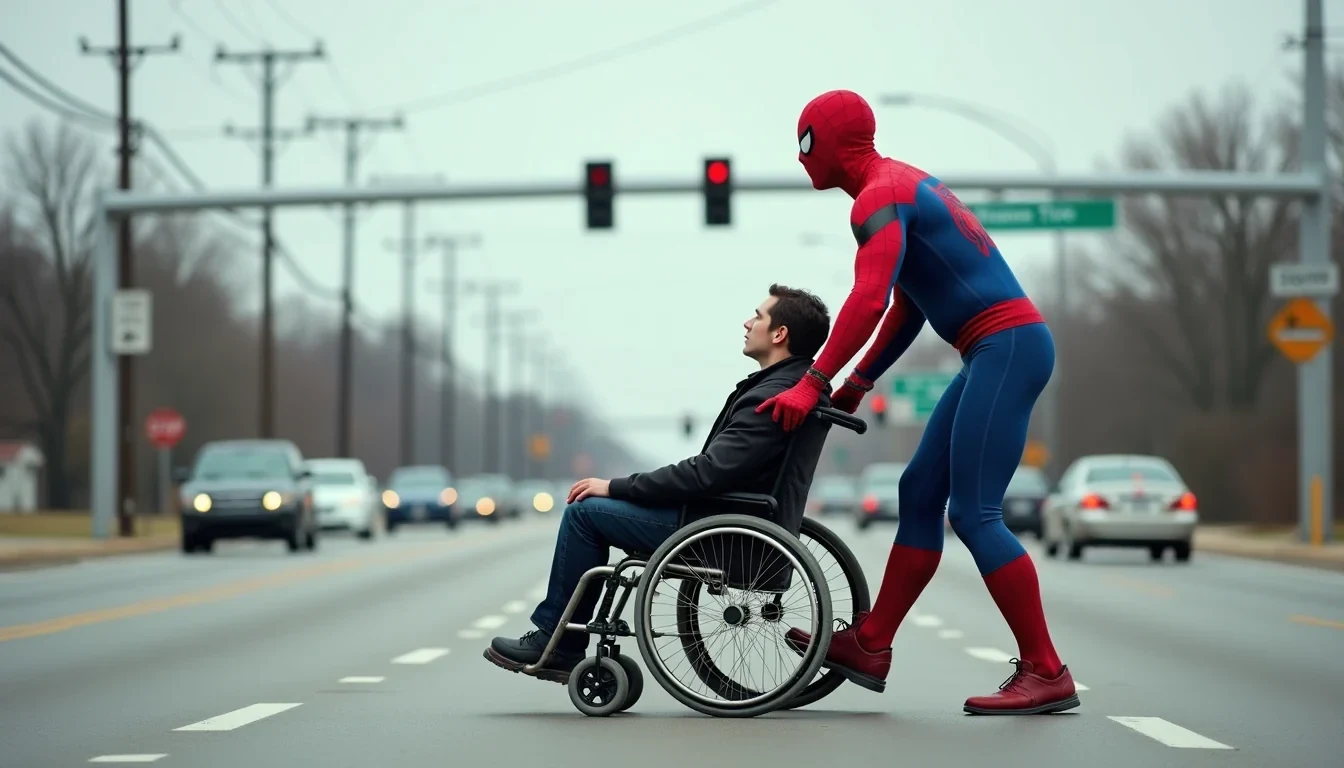
Christopher Hellenthal turned a red Jeep, a Spider-Man suit, and a split-second decision into the most shared thing in Jonesboro. A 20-year-old, fresh off a superhero-themed shift at an Arkansas trampoline park, saw a wheelchair user struggling at a six-lane intersection, jumped out, and pushed him through before the cars were released.
The clip plays like the internet’s favorite kind of clean little miracle. A stranger notices trouble, moves fast, and leaves with applause. That version is easy to enjoy, but it also papers over the uglier truth under the footage: a city crossing should not be so badly built that a costumed passerby becomes the safety plan.
What happened at the crossing
What actually happened
Hellenthal had just finished work at the trampoline park event and was driving through Jonesboro still wearing the Spider-Man outfit when he spotted the wheelchair user trying to get across. He stopped his red Jeep, ran into the road, and told the man, “I got you,” before pushing him to the far side of the intersection.
The timing was tight enough to make the whole thing feel like a movie edit. A street-security camera caught the entire sequence, including Hellenthal jogging back to his vehicle as soon as the signal changed. Jonesboro police then posted the footage, which sent the clip flying across social media and pulled in tens of thousands of reactions.
Part of the appeal was obvious. A Spider-Man suit turns a quick act of judgment into a ready-made headline. People love a tidy visual, especially one that lets them feel good in under a minute. The predictable joke followed too, with commenters grumbling that he did not finish the moment with a Spider-Man pose. This shows how fast the internet turns a real access problem into a bit.
Why the clip caught fire
The aftermath
The hero story works because it is simple. A young guy in costume helped somebody cross the street, and nobody got hurt. Fair enough. Hellenthal deserves the praise for moving without hesitation, because plenty of drivers would have sat there and watched the light change.
The more useful reading is harsher. The wheelchair user was not facing a random inconvenience. He was dealing with a street built around vehicle flow, not human pace. Six lanes is a long way to cover in one signal cycle, and the usual timing of crossings is built around an average walking speed that already leaves many people behind. If you are in a wheelchair, every extra yard, second, and gap in the traffic phase matters.
The real failure sits here. A crossing that wide should have safety features that reduce the panic factor, not increase it. Short signal times, no safe waiting space in the middle, and the absence of assistance all stack the odds against anyone who moves slower than a brisk pedestrian. The result is not just inconvenience. It is a situation where getting across can depend on luck, weather, driver patience, and, in this case, a man in a superhero suit happening to be nearby.
The internet wanted a feel-good clip, so it got one. Jonesboro got a reminder that accessibility is not a charity event or a bonus feature. It is supposed to be baked into the street itself. When a wheelchair user needs a stranger to clear six lanes before the light flips, the problem is bigger than the man in the costume. He is the headline; the crossing is the issue.
The most honest reaction is not to celebrate the rescue and stop there. It is to look at the road layout and ask why the city had built a place where a decent impulse had to outrun the signal. A good deed happened, but a design failure made it necessary.