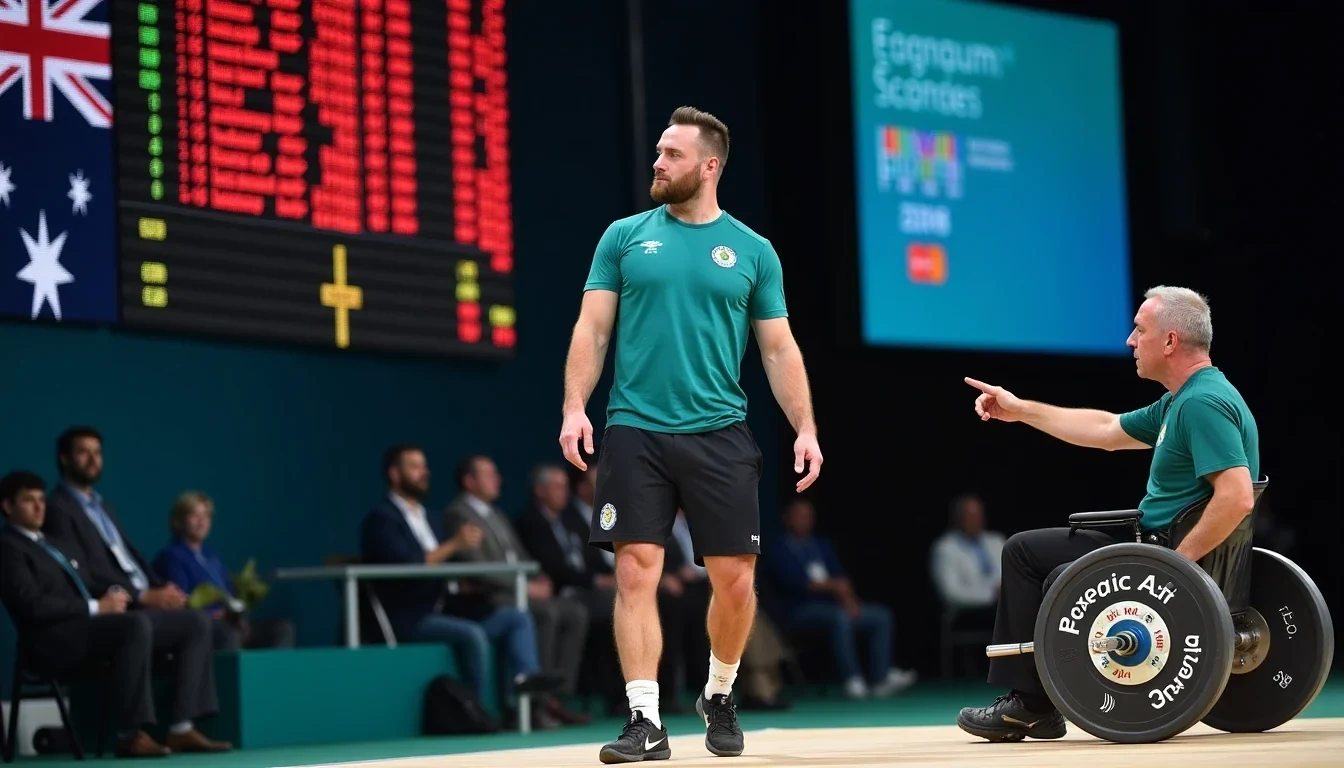
Mark Swan walked off the platform thinking he had bronze, then got told he had gold by someone in his own corner. This kind of result should belong in a pub argument, not a Commonwealth Games final. But there it was, printed on the scoreboard with a straight face, hidden behind a decimal nobody in the arena could see.
The England para powerlifter had just hoisted 222kg, a personal best and more than three times his own body weight. On the screen, his coefficient sat at 153.9. Nigeria’s Roland Ezuruike was also on 153.9. Malaysia’s Bonnie Bunyau Gustin, a two-time Paralympic champion, was only 0.4 points back. Swan had missed his last attempt, Ezuruike had missed his, and the whole thing looked dead level until the officials dug into the numbers and found the hidden digit that separated first from second.
What actually happened
Swan was competing in the men’s lightweight para powerlifting class at the Birmingham 2022 Commonwealth Games, in the up to 72kg category. The system worked as designed. It uses a coefficient formula that adjusts for bodyweight, allowing athletes in different size brackets to be ranked against one another on a single scale, rather than just rewarding the heaviest raw lift.
This is how Swan’s 222kg became a 153.9 coefficient score. It was also how Ezuruike landed on the same visible number, and why the bronze-looking moment on screen turned into something else entirely. The scoreboard gave the crowd the broad picture, but not the fine print. The real separation sat in the second decimal place, which the public never saw. Swan’s exact score was fractionally higher than Ezuruike’s, enough to hand him the gold medal.
This is the weird beauty and the ugly headache of the whole thing. The maths worked, picking the correct winner with clinical precision. But for everyone watching, and for the athletes themselves, the decisive information was effectively invisible. Two lifters appeared to share first. One had already mentally filed himself in third. Then the result changed not through a dramatic lift, but through a conversation.
Swan’s reaction made perfect sense. His coach congratulated him, and Swan assumed the lads were taking the mick because the board said otherwise. That tiny moment says more about the sport than any polished medal photo ever could. If the scoreboard tells one story and the officials tell another, the athlete is left standing in the middle, waiting for the truth to catch up.
The maths behind it
Para powerlifting must solve a problem that raw weightlifting does not. Athletes are not all built the same, so a straight “who lifted more” contest would flatten the competition into body size instead of strength. The coefficient formula exists to prevent this.
In practice, it turns a lifter’s bodyweight and lifted weight into a normalized score. That way, a lighter athlete can compete fairly against a heavier one, provided the lift is strong enough relative to body mass. In Swan’s case, the formula took a monster 222kg effort and translated it into a number that could be compared directly with Ezuruike’s and Gustin’s. The visible leaderboard showed the result in tenths. The actual ranking depended on far finer detail.
This is where the tension starts. Precision is good; it is the whole point, in fact. But if the audience can only see one decimal place, the sport asks everyone to care about a result they cannot fully read. That is a strange way to stage a medal decider. The system may be fair, but it is not especially legible.
Bonnie Bunyau Gustin finishing just 0.4 points off the lead made the point even sharper. He was close enough to smell gold, but still clearly behind once the full calculation was run. Ezuruike, by contrast, ended up in the brutal middle ground of appearing tied for first while losing on a hidden digit. That is a rough beat for any athlete. It is also exactly the sort of thing that leaves spectators blinking at the screen and asking what they just watched.
The Aftermath
The medal handed to Swan was the first gold of the para powerlifting programme at those Games, which only added to the weirdness of the moment. First golds are supposed to arrive with a roar, a clean scoreboard, a big flag, the whole script. Instead, this one arrived via admin and confusion, with the winner only half aware he had won.
Swan’s disbelief gave the story its bite. He did not get a grand cinematic reveal. He got told by his coach while the scoreboard still seemed to say he was third. That gap between what the numbers showed and what the officials knew is exactly why the moment travelled so fast. People can handle tension. They cannot resist a result that looks wrong until a hidden detail makes it right.
The sport got the ranking correct. No argument there. But the viewing experience was messy, and that matters. In a live event, especially one deciding medals, the result has to be more than accurate. It has to be understandable in real time. When the winning difference is buried in a decimal place nobody can see, the competition becomes less about what happened on the platform and more about who gets the explanation first.
This is the part that sticks. Swan did the lift, Ezuruike did the same, the board showed a tie, and gold belonged to the man who looked like he had lost it. The machinery of scoring was exact. The spectacle around it was a mess.