
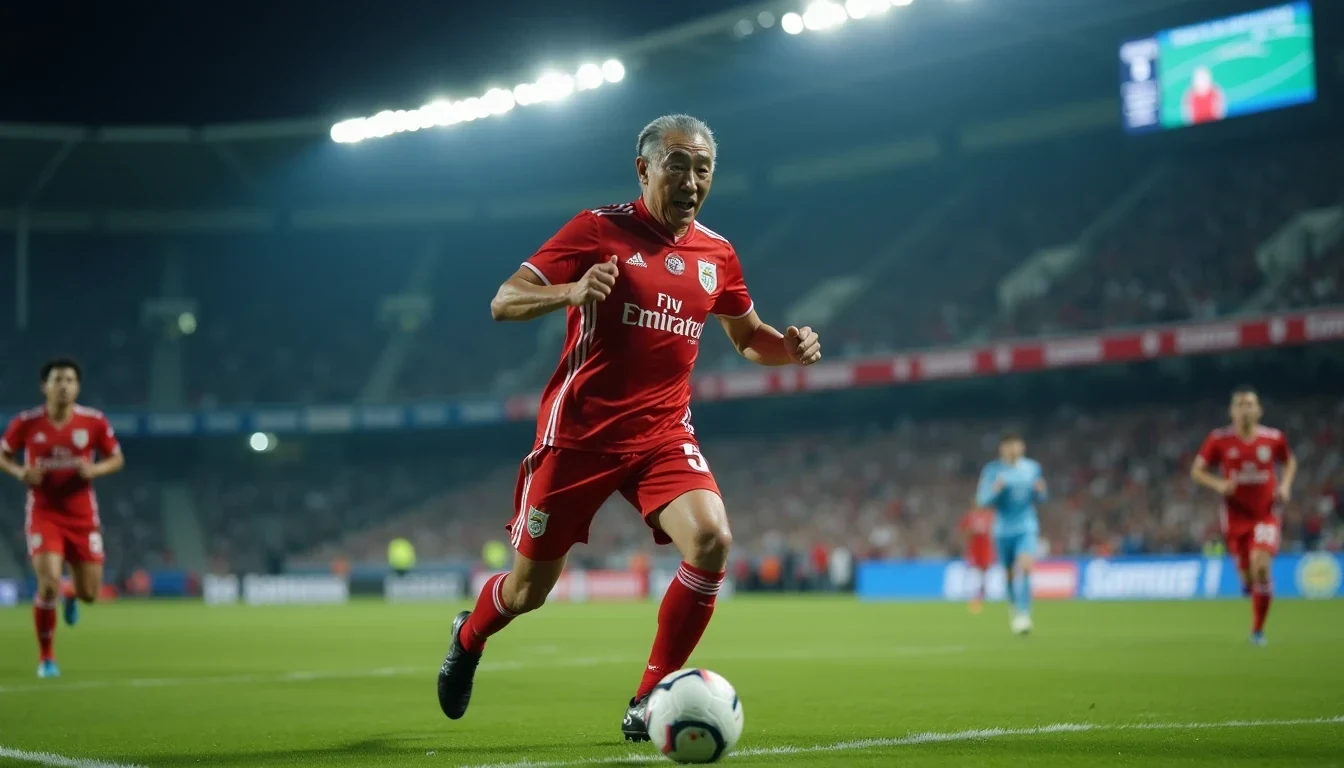
Kazuyoshi Miura, 59 years and 149 days old, walked onto the pitch, accepted a cutback on the edge of the box, and buried it to make the score 5-0. Three minutes later he was subbed off, his work done, his name back in the headlines. The goal itself was almost insultingly simple, but the context was not.
This was the Emperor’s Cup, Japan’s national knockout competition. Miura’s strike for Fukushima United against Iwaki Furukawa on May 22, 2024, ended a goal drought stretching back to November 2022. His loan from Yokohama FC runs until June 2027. He is preparing for his 42nd professional season, having started in 1986. Somewhere a 58-year-old accountant who tore his hamstring playing five-a-side last Thursday is reading this and feeling personally attacked by the universe.
What Actually Happened
The mechanics of the goal barely merit description. A teammate pulled the ball back, Miura finished clinically, and the score became 5-0 in a match Fukushima United would win 7-0. The cutback came in the 52nd minute. By the 55th he was on the bench, presumably conserving energy for whatever absurd milestone comes next.
The scaffolding around that moment is important. This was not a testimonial, a charity runout, or a president-for-life granting himself minutes at the club he owns. Miura is contracted, selected, and substituted based on footballing logic, however stretched that logic becomes when applied to a man who debuted during the Reagan administration.
His career arc defies compression: Serie A with Genoa, the J1 League, Brazil, where he earned the “King Kazu” nickname that followed him home, and over 80 caps for Japan. This is the standard biography of a genuine star, except it kept going decades after it should have stopped, then kept going some more.
The Aftermath
Within hours, the record books were being consulted, debated, and selectively quoted. Miura is widely recognised as the oldest professional goalscorer. The word “professional” is doing heavy labour there.
Ezzeldin Bahader demands consideration. The Egyptian scored a penalty for 6th October club in March 2020 at 74 years and 11 days old, in what was technically a third-division match. Guinness World Records certified him the “oldest professional footballer.” Whether that certification matches what most people mean by “professional football” is where the argument starts. The Egyptian third division’s relationship to full-time professional sport is, charitably, a complicated one. Bahader’s achievement is genuine, but its comparability to Miura’s sustained career is not.
Innocent Benza occupies different territory again. The Zimbabwean scored for Herentals FC, a club he owns, in the Premier Soccer League in April 2023 at 51 years and 181 days. This was top-flight football in a recognised national league, older than most players manage, younger than both Miura and Bahader. The ownership detail adds flavour, the league level adds legitimacy, and the age adds another data point to an increasingly crowded field.
The categories multiply fast: oldest in a top-tier league, oldest in any professional league, oldest in a national cup, oldest in any registered competitive fixture, oldest while genuinely contributing versus oldest while technically present. Each definition produces a different winner. No governing body exists to adjudicate between them.
Why the Record Refuses to Settle
The problem is not lack of information but excess of frameworks. “Professional” means full-time contract and salary in some contexts, and mere league registration in others. A goal in Japan’s J3 League, where Miura now operates, carries different weight from a goal in the J1 where he spent his prime. The Emperor’s Cup is competitive but knockout, distinct from the grind of league football.
Miura’s defenders, and they are legion, point to continuity. This is not a man who made a cameo for the cameras. He has been continuously employed as a professional footballer since 1986, across four decades, across continents, and across the transition from VHS to streaming. His body has been subjected to training regimes, travel schedules, and selection pressures that would break most humans within months. The goal at 59 was not a stunt; it was the latest entry in a ledger that should have closed long ago.
His critics, such as they are, note that the goal came in a cup match against lower-tier opposition, that he was immediately withdrawn, and that the J3 League itself is professional in name more than financial reality. These are fair observations that miss the point entirely. The point is that any of this is possible at all.
What Miura Actually Represents
The sporting record that matters here may not be the oldest goalscorer at all. It is the 42 professional seasons, the loan extending to age 62, and the refusal to transition into coaching or punditry or the comfortable afterlife of the ex-player. Miura has outlasted teammates who became managers, managers who became directors, and directors who became historical footnotes.
Football is not kind to aging bodies. The acceleration of the modern game, the pressing systems, and the GPS-tracked sprints all suggest a sport moving away from Miura, not toward him. Yet here he remains, contracted until 2027, still finding the net occasionally, and still generating headlines that oscillate between celebration and disbelief.
The debate over “oldest goalscorer” will not resolve because the terms are irreconcilable. Bahader was older. Benza was higher level. Miura has been both longer and more consistently than either. Choose your metric, choose your champion, and understand that your choice reveals your values more than it settles the question.
What Miura scored against Iwaki Furukawa was not merely a goal. It was another refusal to exit the stage, another data point in an experiment that should have failed decades ago, and another reminder that the categories we construct to make sense of sport buckle under sufficient pressure. The record books will remain messy. King Kazu will remain playing. One of these facts is more interesting than the other.